NOTE: 현업에서 이진 트리 개념이 사용되는 사례 (링크)
1. Spanning Tree
A tree T is a spanning tree of a graph G if T is a subgraph of G that contains all of the vertices of G.
- Every connected graph has a spanning tree.
- Any two spanning trees for a graph have the same numbers of the edges.

- A graph G has a spanning tree if and only if G is connected.
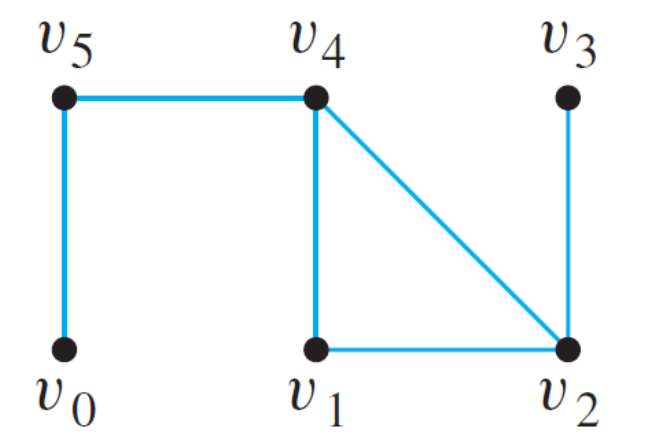
The graph G has one circuit v2-v1-v4-v2, and removal of any edge of the circuit gives a tree. Thus, as shown below, there are three spanning trees for G.

Spanning tree search method
- BFS : process all the vertices on a given level before moving to the next-higher level
- DFS : proceeds to successive levels in a tree at the earliest possible opportunity (Backtracking)
(1) BFS
bfs(V, E) {
// V = vertices ordered v1,..., vn; E = edges
// V′ = vertices of spanning tree T; E′ = edges of spanning tree T
// v1 is the root of the spanning tree
// S is an ordered list
	S = (v1)
	V′ = {v1}
	E′ = ∅
	while (true) {
		for each x ∈ S, in order,
			for each y ∈ V − V′, in order,
				if ((x, y) is an edge)
					add edge (x, y) to E′ and y to V′
		if (no edges were added)
			return T
		S = children of S ordered consistently with the original vertex ordering
	}
}
Process all the vertices on a given level before moving to the next-higher level.

- select a (root)
- add to T all edges (a,x) and vertices on which they are incident that do not produce a cycle when added to T.
- repeat this procedure on level 1. (b, c, g)
- repeat this procedure on level 2. (d, e)
- repeat this procedure on level 3. (f)
- repeat this procedure on level 4. (h)
(2) DFS
dfs(V, E) {
// V′ = vertices of spanning tree T; E′ = edges of spanning tree T
// v1 is the root of the spanning tree
	V′ = {v1}
	E′ = ∅
	w = v1
	while (true) {
		while (there is an edge (w, v) that when added to T does not create a cycle in T) {
			choose the edge (w, vk) with minimum k that when added to T does not create a cycle in T
			add (w, vk) to E′
			add vk to V′
			w = vk
		}
		if (w == v1)
			return T
		w = parent of w in T // backtrack
	}
}
Proceeds to successive levels in a tree at the earliest possible opportunity

- Select a (root)
- Add the edge (a, x), with minimal x, to our tree. (a, b)
- Repeat this process. (b, d), (d, c), (c, e), (e, f), (f, h)
- We cannot go further. We backtrack to the parent f of h and try to add an edge of the form (f, x)
- We cannot go further. We backtrack to the parent e of f and try to add an edge of the form (e, x).
→ Add (e, g)
Example
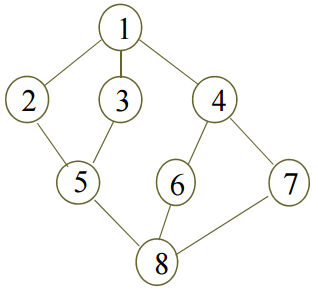
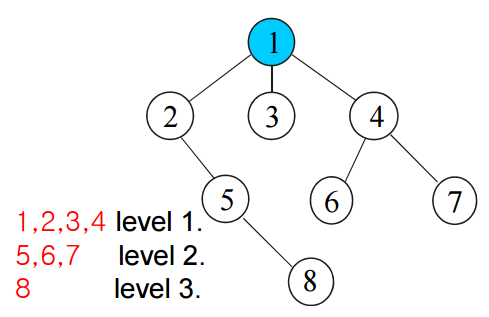
- 위 그래프를 BFS로 탐색하면, 순서는 1-2-3-4-5-6-7-8 순이 된다.
- 위 그래프를 DFS로 탐색하면, 순서는 1-2-5-3-8-6-4-7 순이 된다.
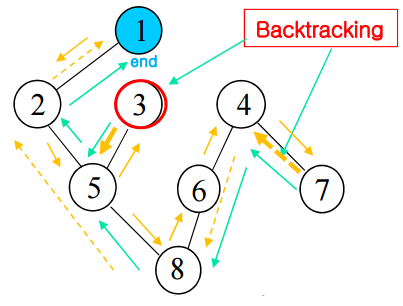
- 1 → 2 → 5 → 3
- 3에서 backtracking 발생 (5 → 8 → 6 → 4 → 7로 진행)
- 7과 인접하면서 탐색되지 않은 vertex가 없으므로 backtracking 발생 (4 → 6 → 8 → 5 → 2 → 1)
2. Minimun Spanning Tree
Let G be a weighted graph. A minimal spanning tree of G is a spanning tree of G with minimum weight.
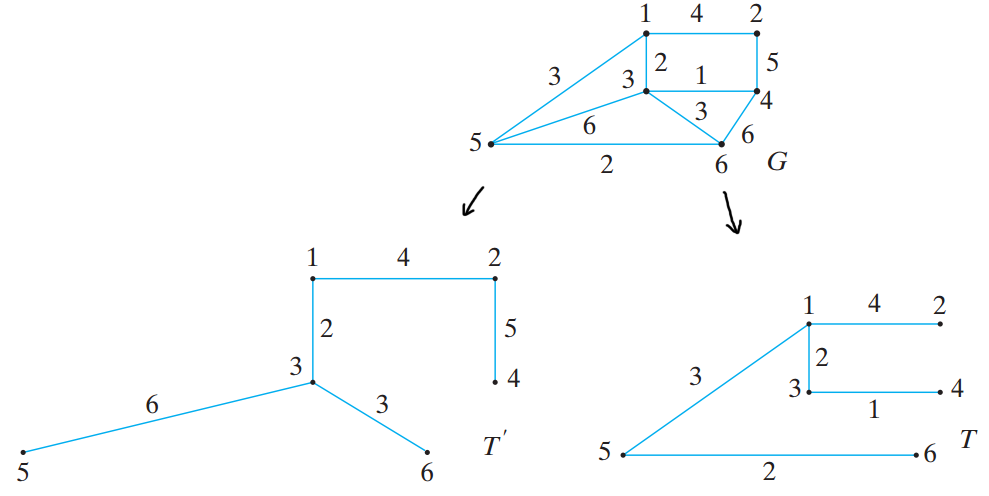
For a weighted graph G, there are two spanning trees, T and T'. T' with weight 20 is not a minimal spanning tree since spanning tree T has weight 12. We will see later that T is a minimal spanning tree for G.
MST search algorithms
- Prim's Algorithm : A example of Greedy algorithm
- Greedy algorithm : 이전의 선택은 고려하지 않고 각각의 iteration에서 최적화시킴 → doing the best locally
- Kruskal’s algorithm
(1) Prim's algorithm
This algorithm finds a minimal spanning tree in a connected, weighted graph.
- Input: A connected, weighted graph with vertices 1,..., n and start vertex s. If (i, j) is an edge, w(i, j) is equal to the weight of (i, j); if (i, j) is not an edge, w(i, j) is equal to ∞ (a value greater than any actual weight).
- Output: The set of edges E in a MST
prim(w, n, s) {
	// v(i) = 1 if vertex i has been added to mst
	// v(i) = 0 if vertex i has not been added to mst
	for i = 1 to n
	v(i) = 0
	// add start vertex to mst
	v(s) = 1
	// begin with an empty edge set
	E = ∅
	// put n − 1 edges in the minimal spanning tree
	for i = 1 to n − 1 {
		// add edge of minimum weight with one vertex in mst and one vertex
		// not in mst
		min = ∞
		for j = 1 to n
			if (v(j) == 1) // if j is a vertex in mst
				for k = 1 to n
					if (v(k) == 0 ∧ w(j, k) < min) {
						add vertex = k
						e = (j, k)
						min = w(j, k)
	 				}
		// put vertex and edge in mst
		v(add vertex) = 1
		E = E ∪ {e}
	}
	return E
}- min=w(i, j) : 하나의 vertex v(j)는 mst에 속하고 다른 vertex v(k)는 mst에 속하지 않는 edge w(j,k)중에서 최소치 edge 선택
- 각각의 반복에서 최적화하는 것이 항상 optimal solution은 아니다. → Greedy Algorithm의 한계
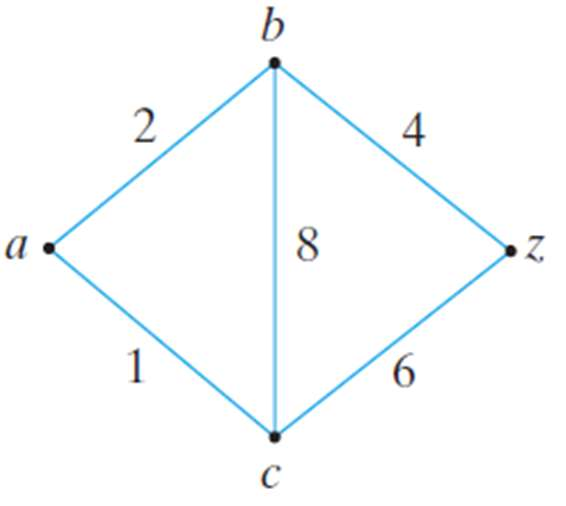
- Greedy Algorithm으로 MST : (a, c) (c, z), (z, b) → 11
- Prim’s Algorithm으로 MST : (a, c) (a, b), (b, z) → 7
Prim’s Algorithm is CORRECT; that is, at the termination of Prim's algorithm, T is a minimal spanning tree.
(2) Kruskal’s Algorithm
- Find the edge in the graph with smallest weight (if there is more than one, pick one at random).
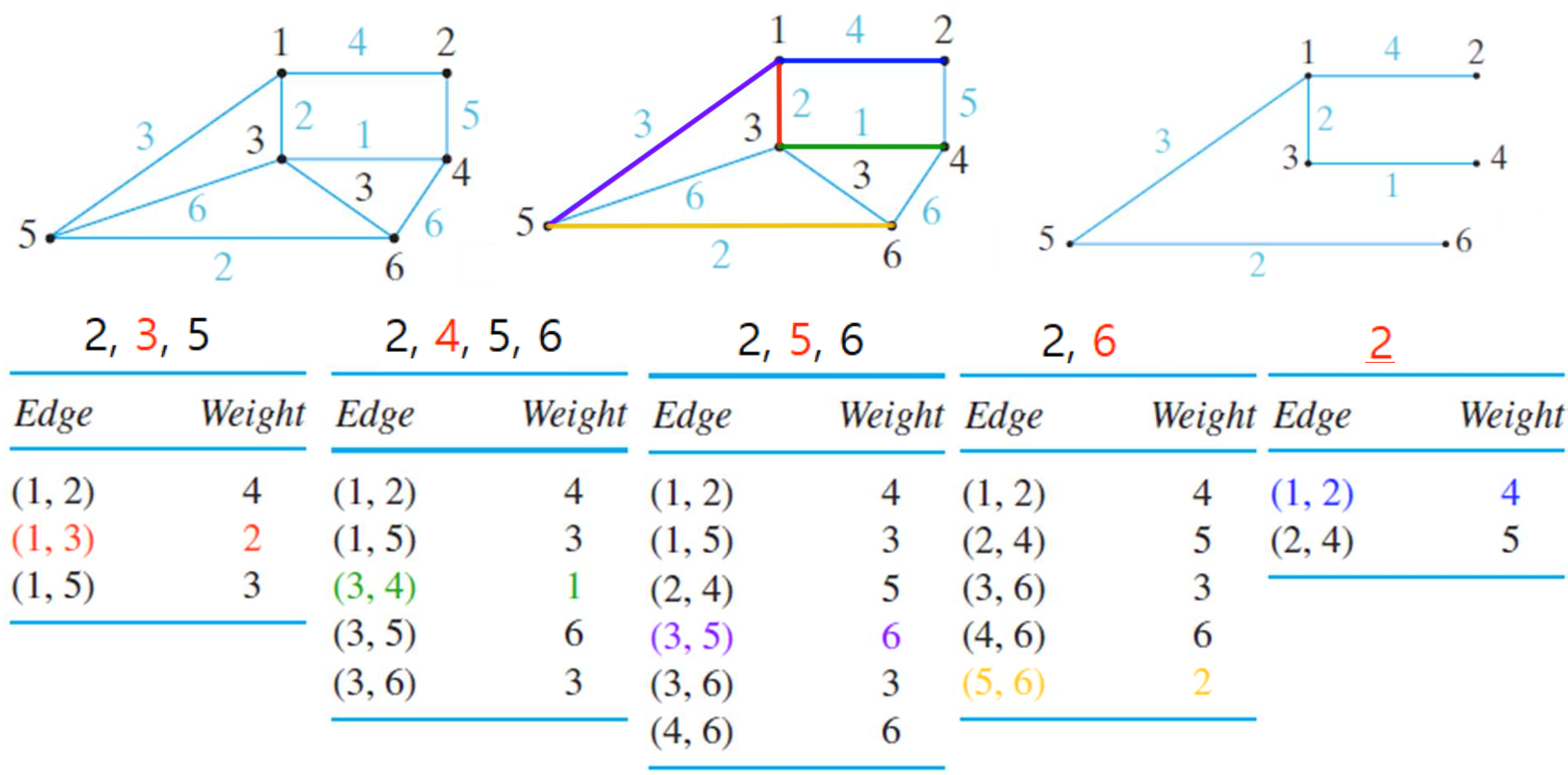
Mark it with any given color, say red.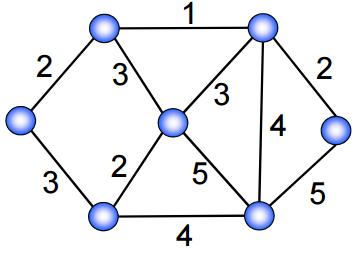
- Find the next edge in the graph with smallest weight that doesn't close a cycle.
Color that edge and the next incident vertex.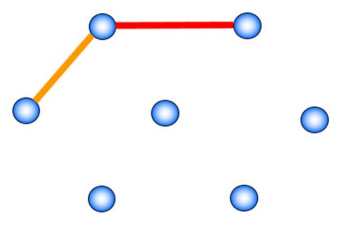
- Repeat Step 2 until you reach out to every vertex of the graph. The chosen edges form the desired minimum spanning tree.
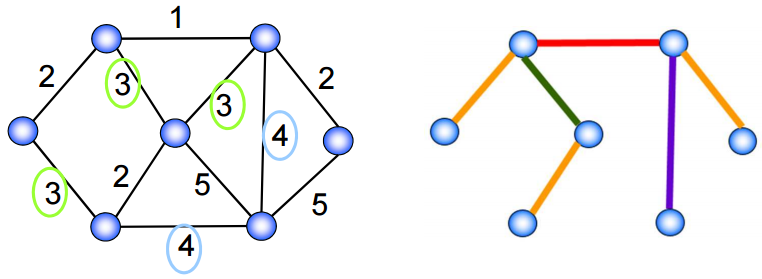
1+2+2+2+3+4=14
Prim, Kruskal 알고리즘 둘 중 아무것이나 선택해서 풀어도 답은 동일하다.
3. Binary Tree
A binary tree is a rooted tree in which each vertex has either no children, one child, or two children. If a vertex has one child, that child is designated as either a left child or a right child (but not both). If a vertex has two children, one child is designated a left child and the other child is designated a right child.
- Full binary tree : a tree in which each vertex has either two children or zero children
- If T is a full binary tree with i internal vertices, then T has i + 1 terminal vertices and 2i + 1 total vertices.
- If a binary tree of height h has t terminal vertices, then log₂ t ≤ h.
- Is there a binary tree that has height 5 and 38 terminal vertices?
→ No! any binary tree T with height 5 has at most 25 = 32 terminal vertices, so such a tree cannot have 38 terminal vertices.
- Is there a binary tree that has height 5 and 38 terminal vertices?
A binary search tree is a binary tree T in which data are associated with the vertices. The data are arranged so that, for each vertex v in T, each data item in the left subtree of v is less than the data item in v, and each data item in the right subtree of v is greater than the data item in v.
make bin search tree(w, n) {
	let T be the tree with one vertex, root
    store w1 in root
	for i = 2 to n {
		v = root
		search = true // find spot for wi
		while (search) {
			s = word in v
			if (wi < s)
				if (v has no left child) {
					add a left child l to v
					store wi in l
					search = false // end search
				}
				else
					v = left child of v
			else // wi > s
				if (v has no right child) {
					add a right child r to v
					store wi in r
					search = false // end search
				}
				else
					v = right child of v
		} // end while
	} // end for
	return T
}
4. Tree Traversal
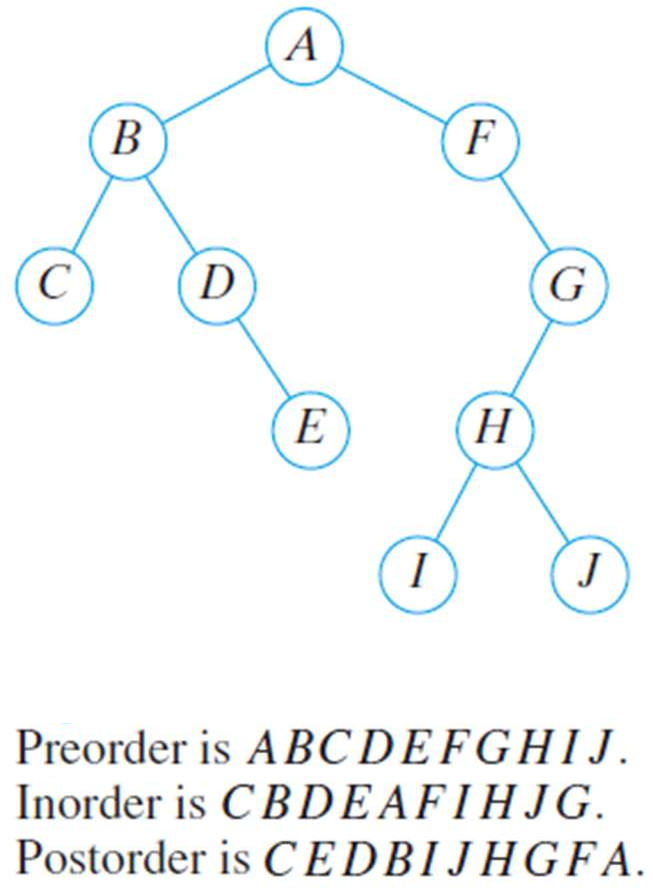
(1) Preorder Traversal
preorder(PT) {
	if (PT == null)
		return

	process PT
	preorder(left child of PT)
	preorder(right child of PT)
}
(2) Inorder Traversal
inorder(PT) {
	if (PT == null)
		return

	inorder(left child of PT)
	process PT
	inorder(right child of PT)
}
(3) Postorder Traversal
postorder(PT) {
	if (PT == null)
		return

	postorder(left child of PT)
	postorder(right child of PT)
	process PT
}
'공부' 카테고리의 다른 글
| [Algorithm] Depth-First Search (0) | 2025.03.30 |
|---|---|
| [Algorithm] Dynamic Programming (0) | 2025.03.30 |
| [Discrete Mathematics] Graph Theory (0) | 2025.03.27 |
| [Discrete Mathematics] Recurrence Relations (0) | 2025.03.16 |
| [Discrete Mathematics] Number Theory (0) | 2025.03.16 |